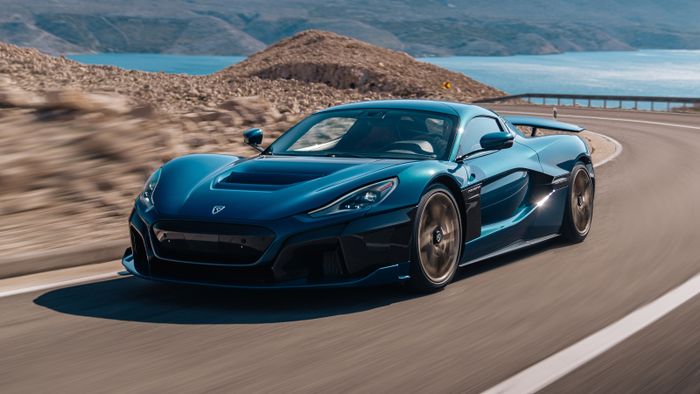

Powered by a 120kWh battery pack, the Nevera uses four electric motors — one for each wheel — to produce 1,914 horsepower. The quad-motor setup can push the car to 60 miles per hour from a standstill in just 1.85 seconds to a quarter mile of an insane 8.61 seconds and not on a drag strip, it’s powerful motors will Push the car to a mind blowing top speed of 258 miles per hour (412 kilometres per hour)
What’s more, Rimac says one of the things it worked on over the last three years was improving the battery pack’s liquid cooling system, meaning drivers can use that peak power for longer before the batteries start to lose power
To make sure drivers have a fighting chance at controlling that amount of power, Rimac developed a new all-wheel torque vectoring system that basically acts as both an electronic stability and traction control system. The software can make “over 100 calculations per second to tailor the level of torque to achieve the desired driving style,” Rimac says in the press release for the Nevera. Braking in a car like this is also important, and Rimac has designed the Nevera to be able to dynamically adjust the balance of the braking force between the friction brakes in the wheels and the regenerative braking made possible by the electric motors.

Image: Rimac

Image: Rimac
If that’s not enough, Rimac has developed an “AI driving coach” feature that leverages the Nevera’s 12 ultrasonic and six radar sensors, as well as 13 cameras to help “optimize and enhance the driver’s on-track performance.” It does this by providing track-specific audio and visual cues for when to brake for, where to turn into, and when to accelerate out of a corner.
Of course, very few people will have to worry about whether they can properly pilot a Nevera. Rimac is only making 150 of them, and they’ll each start around $2.4 million.
A big part of that price tag is Nevera’s lavish tech. The monocoque is the largest single carbon fiber piece in the automotive industry, according to the company, dramatically cutting weight and improving safety. The H-shaped battery pack is structurally integrated into that monocoque, too, keeping the center of gravity low and adding to the overall structural stiffness. To keep the ride smooth, the Nevera has a double wishbone suspension that uses electronically controlled dampers, which also makes for easy ride height adjustments.
Inside the cockpit, there are three screens: a driver display, a horizontal touchscreen in the center console, and a passenger display. There’s also an accompanying mobile app, which offers live track data, and the ability to download telemetry so drivers can analyze their performance.
An incredible car and one that proves in many ways that electric is exciting and it’s definitely the future.
 Car content